'In these days of a communication revolution, was it necessary for him to go to every country?' 'Mahatma Gandhi had no internet or a twitter account, but the whole world recognised him as the greatest leader of the twentieth century,' says Ambassador T P Sreenivasan.
India is likely to announce its targets for the Paris deal by September-end.

'That the two sides allowed such a situation to arise exposed the level of inaction and inefficiency in China-India border management.' 'The Modi-Xi meeting in Xiamen initiated a process to to avert such contingencies in the future.'
'Will it lead to a full-scale war? I doubt it.' 'But I do think there will be some kind of limited conflict.'
'There is hope that in the next 48 to 72 hours there will be some kind of movement forward to de-escalate and not heighten the tension.'

Even as the United States snuggles closer to India with the thinly veiled objective of containing China, the Indian strategy is to avoid alienating either nation.

'One lesson to emerge out of the Modi-Putin summit is that India can be more self-confident that it possesses inherent strengths to leverage its interlocutors to influence Pakistani policies,' says Ambassador M K Bhadrakumar.
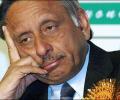
Escalating its attack against Mani Shankar Aiyar, the BJP called his remarks "treasonous" and demanded an apology from Congress chief Sonia Gandhi.
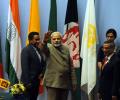
'If his three priorities are the economy, the economy, the economy, then there is need for a stable region, a stable neighbourhood.'
'Terrorism is merely a symptom of a deeper disease in Pakistan's body politic,' says Colonel Anil A Athale (retd).

'The public has unfair expectations from Mrs Swaraj who is in Islamabad primarily for the Heart of Asia Conference. To restore India's position among stakeholders on Afghanistan is a fair one but to expect her to do more on the Indo-Pak front without requisite preparatory work is unrealistic.'
'Whichever way you look at it, it is a blow to the JeM and to the Pakistani army in general; the attack has taken place in mainland Pakistan and not in PoK.'

Moving ahead with their new mantra -- Chalein Saath Saath: Forward Together We Go -- Prime Minister Narendra Modi and United States President Barack Obama on Tuesday vowed to deepen cooperation in every sector for the benefit of global stability and people's livelihoods over the next ten years.

The joint statement issued after Prime Minister Narendra Modi and President Barack Obama's first-ever summit is high on intent and ambition. Notably missing from the statement is India's refusal to be America's partner in its war against ISIS.

The G-4 foreign ministers' grouping, that includes India, on Thursday called for urgent reform of the United Nations, including the Security Council, an issue that India has emphasised for the past several years.

'The Chinese forces in the narrow Chumbi Valley are currently in the line of sight and fire of Indian forces poised on the ridges along the Sikkim-Tibet border.' 'Aware of this vulnerability, the Chinese have been eyeing the Doklam plateau,' explains national security expert Nitin A Gokhale.
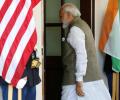
We see none of the euphoric build-up customary to India's encounter with US presidents in recent times. This gives Modi wriggle room to work on the much-needed reset of India-US ties.

Sanctions against North Korea following its H-bomb test could have serious repercussions and may prove disastrous for all the players involved, says Debalina Ghoshal.

'Washington is telegraphing here is its willingness to support a low-grade, limited use of force meant to send a strong message to Pakistan.' 'Perhaps something along the lines of the surgical strikes in 2016, or perhaps something a bit more -- but not much more.'

If the chemistry between Modi and Xi Jinping goes well, it will herald a new future not just for the region but for the world, says Tarun Vijay.

The US intends to break up India's strategic partnership with Russia and to continue to interfere in Indian-Iranian relations, apart from inserting itself into the Sino-Indian bilateral discourse, says Ambassador M K Bhadrakumar, analysing the US defence secretary's visit to India.

'Assuming the official defence allocations represent the true picture, the $142 billion figure still represents a phenomenal increase and surpasses that of Japan ($42 billion), India ($40 billion), South Korea ($33 billion) and several other Asian countries put together and shows that China is flexing its military muscle.'

Russian President Vladimir Putin has warned the United States against any unilateral military stike on Syria, saying it would trigger a new wave of terrorism, result in the collapse of the United Nations and claim more innocent victims as the conflict could spread beyond Syria's borders.

'When it comes to India-Pakistan relations, seminal moments of progress invariably bring out saboteurs of peace -- whether we're talking about fresh provocations along the LoC, or even a terror attack in India.'

'Modi's promise of change during the election campaign was on the domestic front, but his first year in office focused on foreign policy beyond all expectations,' says Ambassador T P Sreenivasan.

'Xi Jinping got a dose of Modi's medicine inside the tent where he was being hosted on the banks of the Sabarmati river.' 'Modi reportedly told him, looking deep into his eyes: "This was not expected of your country. Can you tell me when the troops are withdrawing?".'

Amid souring ties, the president visited Beijing for three days. On his return to India, a hope of better ties has arisen, says senior correspondent R Rajagopalan, who travelled with Pranab Mukherjee to the Asian superpower.

As India strives to make its Act East Policy a comprehensive politico-diplomatic and economic success, Brunei gains more salience, says Dr Rahul Mishra.

'The BRICS anthem has to necessarily be an anthem of Vedic times -- Walk together, Dream together, Achieve together.' 'And who knows it better than Modi?' says Tarun Vijay.
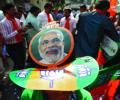
Retired senior US diplomats Teresita and Howard Schaffer believe the 'US cannot afford to continue restricting its contacts with Narendra Modi.' Rediff.com's Aziz Haniffa reports from Washington, DC.
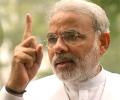
To be sure, Modi is no Vajpayee; at least that is the impression he gives. However, this doesn't mean that he will be looking for a fight. All it means is that if Pakistan seeks a fight, he will not back down. What it also means is that the pusillanimous approach of the previous governments to ceaseless provocations from Pakistan will probably change, says Sushant Sareen.

New Delhi and Beijing are the only two regional capitals that have commented on US President Donald Trump's speech on August 21 outlining the way forward in Afghanistan. The Indian foreign ministry statement was effusive in praise, while the Chinese statement has been one of cautious and guarded hope. Delhi has identified itself with Trump's Afghan strategy, whereas the Chinese stance is calibrated -- observant and objective, keeping a distance, says Ambassador M K Bhadrakumar.
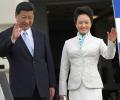
'India and China have to make concrete progress with regard to the border issue, addressing the trade deficit, and facilitating people-to-people interactions. This has to happen in the next two, three years.' China expert Tansen Sen tells Sheela Bhatt/Rediff.com how India and China can take their relations to the next level.

India comes under attack over religious intolerance, human trafficking and slavery at a Senate Foreign Relations Committee hearing.

'The book has immense value because it reveals the inner workings of the think-tank which appears to provide facts and insights to Modi, though he himself takes the final decisions and articulates them in his characteristic rhetorical style,' says Ambassador T P Sreenivasan.

The Japanese prime minister's visit to the memorial in Hawaii, the spot that was bombed 75 years ago, shows that it is possible for two powerful former enemies to transcend recriminatory impulses, observes Rajaram Panda.

Obama's decision to visit India must be a result of his judgement that Modi is a man of action, feels Ambassador T P Sreenivasan.

'To expect that he has a magic wand to resolve all differences and announce breakthroughs in all issues during his first visit to the US is to be unrealistic,' says Ambassador T P Sreenivasan.
'If India employed a strategy of a 'thousand cuts', Pakistan will wither away.'

It was clear in Brunei at the 8th East Asia Summit that China doesn't want the South China Sea issue to even dominate the discussion, reports Sheela Bhatt, who is part of the prime minister's media contingent to the summit
